Tuesday, 18 December 2012

The Esoteric Influence of Taro Okamoto

Alien named PAIRA, 1956

Visiting the Taro Okamoto Museum of Art is always a fascinating experience. Located in Kawasaki's heavily-wooded Ikuta Ryokuchi Park, the specially designed building seems like a cross between a freemason hall on acid and the cult centre of a cross-eyed messiah.

Strange as this may sound, it is only to be expected. During his early life, when he was studying art in Paris, Okamoto became fascinated by esotericism and occultism. He attended meetings of the College of Sociology, a group of intellectuals interested in ritualism led by Georges Bataille, and was also initiated into Acéphale, a mystical secret society.

Later, following his return to Japan, Okamoto became a dominating figure on the Japanese art scene. This was only partly due to his art. More important was the French intellectualism that he brought back and adapted to local conditions, along with his mesmeric charisma and media-savvy persona, which allowed him to achieve cult status in the Japanese media.

The exhibition commemorates the 100th anniversary of Okamoto's birth and is divided into two parts. The first part, which finished in July, focused on people who worked with Okamoto. The second part looks at his wider influence as an inspirational figure and cultural phenomenon.

The best way to approach this special exhibition is through the museum's main permanent exhibition, where you can see a selection of some of the artist's most impressive paintings and sculptures. These are brash, often anthropomorphic abstracts, many of which were influenced by his later interest in prehistoric Jomon period pottery and artifacts. This leads to the special exhibition, which is divided into several rooms opening onto a large hall dominated by Alien named PAIRA (1956), a large, inflated star with a giant eye that evokes the All-Seeing Eye, a common mystical symbol in freemasonry.

One of the rooms looks at Okamoto's involvement in architecture, including his collaboration with Kenzo Tange for Tower of the Sun, the symbol of the 1970 Osaka Expo. Another room looks at Taro Ai (Taro Love) a photographic book by Japan's most famous shutterbug, Nobuyoshi Araki.

Like Okamoto, Araki has cultivated a strong public persona and has become famous as much for his image as his art. This suggests a degree of emulation in terms of showmanship. In the actual photos, Araki uses Okamoto's Tower of the Sun and other elements of Okamoto's art in his usual, erotically tinged photos.

Surprisingly for an artist as influential as Okamoto, the exhibition has comparatively few paintings and sculptures by other artists. Those represented include Tadanori Yokoo and Shozo Kitadai. But their works are overshadowed by Ushio Shinohara's vast, sprawling, anarchic canvas, Taro Okamoto Working Outdoors—From Sunrise in Arizona to Sunset in Bermuda (2000). The fact that most of these artworks include representations of Okamoto strengthens the somewhat cultish atmosphere of the exhibition.

Other rooms look at Okamoto's role in the wider media, with clips of interviews and all 60 editions of Japanese Playboy in which he wrote a column answering readers' questions on a wide variety of topics. To contrast the resulting implication of seediness, another room focuses on his scholarly and academic interests, with bookshelves crammed with the works of philosophers and intellectuals. These include Georges Bataille, the Jewish sociologist Marcel Mauss, who taught Okamoto in Paris, and the once anti-Semitic Romanian philosopher Mircea Eliade whose views had the profoundest impact on Okamoto's own theories, according to the exhibition's curator, Hidenori Sasaki.

The diverse elements in Okamoto's mentality revealed by this show suggest that he was a very contradictory character. However, this was something entirely in keeping with his own philosophy, which emphasized contradiction and polarity as creative spiritual forces, rather than the dominant modernist values of logic and synthesis.


C.B.Liddell
Metropolis
7th September, 2011

Monday, 19 November 2012

Leonor Fini: Consciously Painting the Subconscious

Between the Two, 1967

One of my favorite paintings is one by a trained elephant that I picked up on holiday in Thailand daubed by a trained elephant. It's not a very good one, but the story behind it makes it special -- highlighting one of the aspects by which art has come to be judged. In a similar way, the story of Leonor Fini, the Surrealist painter whose works are on view at the Bunkamura, adds a certain mystique and fascination to her art, although, luckily, in her lengthy career, she learned to paint a lot better than the average tourist-friendly elephant.

Her life was marked by a series of dramatic episodes, such as the early divorce of her parents. One year after she was born in Buenos Aires, Argentina in 1907, her Italian mother divorced her father and took her back to Italy, where Fini was routinely disguised as a boy to prevent her estranged Argentinian father kidnapping her and taking her back to Argentina.

Wearing male clothing seems to have played a significant part in her life. When she was living in Paris in 1936, one of her paintings was seen by a member of the Surrealist group and a meeting was arranged. For this pivotal event, she arrived dressed in a cardinal's scarlet robes, a stroke of self-dramatization that established her reputation.

Although the works of female Surrealists, like Dorothea Tanning and Frida Kahlo, have attracted increasing attention recently, Surrealism is still seen as an art movement that was dominated by Freudianism and male notions of desire. Fini's art is supposed to be a woman's take on the movement, and offer a female view of erotic pleasure, but how much paintings of women about to engage in cunnilingus reflect a feminine sexual perspective is open to question.

The fact that such works are among Fini's paintings also explains why this exhibition is being held now, nine years after her death.

"Even a few years ago it was a problem to bring sexually explicit works to Japan," assistant curator Aki Hirokawa points out. She also explains that, despite the clearly lesbian content of paintings like Between the Two (1967), Fini had many male lovers. But this, instead of confirming her feminine sexuality, suggests that she was merely co-opting male sexual norms of promiscuity in a way that created notoriety useful to an artist.

The Interval of the Apotheosis
While earlier artistic movements depicted the external world, Surrealism took the inner world of the subconscious for its territory, both in terms of method and subject. While artists like Andre Masson and Max Ernst developed techniques like automatism and drip painting that sought to bypass conscious creativity, other Surrealists, like Salvador Dali, consciously painted the subconscious world of dreams and visions, as did Fini.

An eye infection in her teens temporarily blinded her, and helped Fini to develop her ability to visualize fantastic images. So, when she came to paint, she was a natural Surrealist -- as shown by The Interval of the Apotheosis (1938-9), an eerie dreamlike scene in which the central figure, interpreted as Fini herself, attempts to place a wig on her knee against a dreamscape populated with witch-like hags.

Portrait of Princess Nawal Toussoun
Despite her affinities with Surrealism, Fini preferred to maintain some distance from the official Surrealist group, dominated by the writer and theoretician, Andre Breton. She saw the group's obsession with manifestos and theories not as radical, but as a symptom of what Dali called a "typical petit-bourgeois mentality." So, while benefiting from her association with Surrealism, Fini was not stifled by it and continued to develop her art in other directions, notably as a costume designer for opera and ballet.


She also distinguished herself as a portrait painter as several examples here testify. Some of these are clearly pictures of friends tossed off in moments of fun, while others are formal, finished portraits of the wealthy and vain, like her excellent Portrait of Princess Nawal Toussoun (1952), which shows a princess of the soon-to-be-deposed Egyptian royal family, painted in what is today an almost shockingly un-Islamic costume, holding a luxuriantly-furred Persian cat. The interesting contrast between the open slender neck of the princess and that of the cat, which is being firmly held, suffuses the work with a subtle tension that gives it energy.

While later paintings sometimes took on a "kittens and clowns" kitschiness, this exhibition shows Fini succeeded in creating a visionary universe that was the perfect foil to her larger-than-life character.


C.B.Liddell
The Japan Times
6th July, 2005

Friday, 26 October 2012

Jackson Pollock: The First Major Japan Exhibition


Despite his art superstar status, Jackson Pollock's avant-gardism has proved a stumbling block in Japan. Surprisingly, "Jackson Pollock: A Centennial Retrospective" is the first major Pollock exhibition ever held in the country, and brings together about 70 works from the artist's relatively short career.

Following the advances made by Cubism, Futurism, Surrealism, and all the other daring "isms" of early 20th century art, there seemed to be no more virgin artistic territory left for aspiring artists to stake out — until Pollock came on the scene during WWII.

Taking inspiration from experimental drip paintings by the German Surrealist Max Ernst, who was sitting out the war in New York, Pollock pioneered Abstract Expressionism and the technique of Action Painting, in which paint was thrown onto a canvas laid on the floor. His results were dense, energetic compositions that were the visual equivalent of the free jazz experiments and Beat poetry of the same period, and made Pollock instantly famous.

The centerpiece of the exhibit, Mural On Indian Red Ground (1950), comes from an unusual source. This large explosion of paint and energy is being lent by The Tehran Museum of Contemporary Art in Iran. Recently valued at $250 million, it is considered the artist's most valuable work, and something of a cultural hostage, having been purchased by the Shah of Iran during the Westernizing period that ended with the 1979 Islamic Revolution. The painting is now usually kept in an underground storage facility, along with works by other "decadent" Western artists that don't fit with the ideals of the current regime.

The astronomical values placed on Pollock's works may seem baffling, given that almost anyone with a few cans of paint and a bad attitude could create them, but their importance is partly historical. During the Cold War they served as ideological symbols of the "total freedom" available in the West. The value also reflects Pollock's celebrity status as the ultimate artistic "hepcat," and his untimely death in 1956 at the age of 44.

The National Museum of Modern Art, Tokyo, until May 6.


C.B.Liddell
Metropolis
29th February, 2012

Takanori Oguiss: the Japanese Utrillo


When I first saw the oil paintings of Paris by the Japanese artist, Takanori Oguiss (1901-1986), I was strangely reminded of the neutron bomb, a weapon notorious for its ability to annihilate humans without damaging buildings. Like the so-called 'clean bomb,' his paintings of deserted city scenes seem to have a marked preference for buildings over people. However, Oguiss's work is very much concerned with 'La Vie,' the life of the earthy and elegant city that became his adopted home and was the inspiration for the great majority of his work. To celebrate the 100th anniversary of his birth, an exhibition of 128 of his works is visiting 8 venues in Japan over the next year, starting at the Meguro Museum of Art, Tokyo.

Originally named Takanori Ogisu, the painter, the son of a rich landowner, regarded the French capital as the fountainhead of art. In 1927, after completing his studies, he moved to Paris and soon started signing his pictures with the more Frenchified version of his family name, 'Oguiss.' In the same way that America is now attracting the cream of Japan's baseball talent, young Japanese painters of the early 20th century felt challenged to test their skills in the 'Major League' of Western art, which, at that time, was undeniably Paris.

One of the advantages of living in a foreign land is that everyday objects are invested with a special alien charm. Rather than paint some over obvious landmark like the Eiffel Tower, Oguiss felt more fulfilled painting mere alleyways and street corners. An early work, Colonne Morris (1928), showing a kiosk or column plastered with posters, reveals the excitement the young artist found in the mundane elements of his foreign existence. His thick, heavy brushstrokes and bold use of color give the column body, while sharper, feverish strokes convey an impression of the confusing jumble of letters on the posters and advertisements.

Among early influences, he counted such luminaries as Renoir, Sisley, and Degas, and these artists clearly inform the range of his brushstrokes, but in terms of subject matter he falls into the same territory as Maurice Utrillo, the French artist who predated him so much in his Parisian subject matter as well as in certain elements of his style.

In the 1930s Paris was alive with a ferment of new ideas from the worlds of physics, psychology, and politics, impacting on and fragmenting the artistic community. Amid this chaos, Oguiss followed his own personal muse in a way that expressed his Japanese character.

One of the characteristics of his style is his lack of pretension or showiness, invoking the very Japanese qualities of wabi sabi – quiet, austere simplicity. This is particularly evident in his paintings of semi-derelict buildings as in Rue St. Gervias (1937) and run down garages, as in Le Garage (1937). Where he departs from this aesthetic of humble beauty, such as in his painting Tour de Cesar a Provins (1964), an impressive looking castle, his work becomes too self-consciously 'arty,' reminding one of stage scenery.

Obsessed with painting buildings, often at close range, the main danger he faced was that of the solid and static qualities of the objects emerging too strongly. In a work like Fruiterie (1930), a depiction of a fruit shop, the energy of his brushstrokes and the vividness of his textures help prevent the painting becoming too settled. There is also a slightly off balance quality that enlivens many of his works. In these ways Oguiss succeeded in his goal of "Painting La Vie without painting people," indirectly capturing a sense of the spirit of everyday human life.

His reason for leaving people out of his paintings can partially be explained by the Japanese concept of ma or emptiness, where an absence is thought to add to the aesthetic appeal.

"If the picture has an empty space, the painter feels inclined to fill it up with people," he once complained of other painters.

Oguiss loved Paris and its people, but he also sensed that there is something transitory and insubstantial about the flow of human life. His way of capturing it, therefore, was to paint the objects most shaped by it, the streets and houses with their beat-up, warm, and lived-in look. Little wonder then, that the supposedly inanimate objects painted by Oguiss still vibrate with life today.

Takanori Oguiss runs until Jun. 3, 2001 at the Meguro Museum of Art, Meguro

C.B.Liddell
Japan Times
23rd May, 2001

Wednesday, 24 October 2012

Shinsui Ito: An Eye for the Ladies

Yubi 1922

Shinsui Ito (1898-1972) was a central figure during Japan's artistic identity crisis in the 20th century. As wave after wave of artistic movements from overseas broke upon these shores, native artists felt compelled to either abandon their own artistic traditions or embrace them even more strongly.

Ito, whose works are briefly on display at the Takashimaya Gallery in Nihonbashi, Tokyo, was one of those artists who chose the latter course, joining the Nihonga movement, which looked to Japan's past -- rather than the confusing plethora of ideas pouring in from abroad -- for inspiration.

When he was 18, he joined Shinhanga Undo, a group that aimed to revive the methods and styles of ukiyo-e. This had a profound influence on the style and themes of his paintings, which abound with the images of nature and feminine beauty found in traditional Japanese woodblock prints.

Joshin (Unsullied Morning) (1930), a beautiful picture depicting a group of naked women bathing in a natural hot spring, combines both of these aesthetics. The color of the bathers is so softened by the steam and blended into the surroundings that it is only the blackness of their hair that first alerts us to their presence.

Nihonga differs markedly from Western painting in the materials used. The emphasis, as with so much in Japanese culture, is on the use of entirely natural materials.

Paper and silk, mounted on board, wall scrolls or folding screens, are used instead of canvas. Perhaps the most important difference, however, is in the paints. Instead of thick oils, Nihonga uses ground mineral suspended in animal glue thinned with water.

This gives the paint a sandy, smoky texture. The effects of this can be seen in Yubi (Fingers) (1922), which shows the almost ghostlike figure of a lady delicately examining her fingertips.

A Western viewer might be disappointed by the lack of expression in the faces of the women, most of whom seem to be hiding their feelings under a mask. But by paying close attention to other details, we are given enough clues to project our own feelings on to these mysterious faces.

Ideyu (Out of the Bath) (1950) shows a beautiful girl who has just emerged from a hot bath. She wears a yukata and dabs the sweat on her neck with a towel. Instead of having a relaxed face, however, her mouth remains closed and her hair is tied up in an elaborate hairdo.

The only clue that she is really relaxed is given by two little strands of hair that hang down on either side of her face, emphasizing her slight drooping posture. This is so subtle you might miss it if you blink.

Sakurabana (Cherry Blossoms) (1950) shows a young girl with the regulation poker face struck by the sudden beauty of the blossoms. The slight backward tilt of her body, combined with the hand raised to a pair of incredibly small, tight lips, gives us a sense that a gasp of delight will escape from her the very next instant.

Ito tends to idealize women. The flipside of this, however, is that sometimes his paintings seem fetishistic, like Asagao to Shojo (Morning Glory With Young Girls) (1948), a work depicting two young girls sucking on some flowers.

A much more accomplished blending of the feminine and the natural is Reijitsu (Beautiful Day) (1934), a vast work stretching over 12 panels of a folding screen. Showing a woman looking at something lost in the tangled branches of an old plum tree, it is only by carefully following her gaze that we discover the small bird she is quietly watching.

Japanese art inspired by the imported artistic movements of the 20th century often looks derivative and dated, but the work of Shinsui Ito retains its sincere beauty and timeless appeal.


C.B.Liddell
The Japan Times
3rd February, 2001

Saturday, 20 October 2012

The Bewitching Art of Fuyuko Matsui

Photo: C.B.Liddell

There's something bewitching about Fuyuko Matsui. I mean that in both senses of the word. Yes, she's rather too beautiful and her art is strangely mesmerizing, but, more than this, she actually seems to have some occult power to interfere with electronic equipment. Arriving at her Tokyo gallery to interview her about her latest exhibition at the Yokohama Museum of Art, my main camera goes on the blink, only to completely recover after I return home.

You may well be thinking, "Idiot! He forgot to charge the battery," but there's no way I'd forget that with the prospect of shooting someone as appealing as Ms. Matsui. Indeed, I even brought a back up camera, which luckily was unaffected by whatever dark spell it is that she emits.

Saturday, 13 October 2012

Belgium's Bicultural Heart of Darkness

Ghent, Evening (1903) by Albert Baertsoen

Looking at the Tokyo listings, I see that there are a couple of exhibitions focusing on bygone civilizations — a not uncommon theme for exhibitions in Japan. The National Museum of Nature and Science is presenting "The Golden Capital of Sican," which looks at one of the South American societies that predated the Incas; while those entering the Tokyo Metropolitan Art Museum can encounter, once again, the manifold riddles of ancient Egypt.

Adding to this exposition of mysterious societies from far and wide, are two other shows that, while masquerading as twin displays of 19th and 20th century painting, shine a light on that most sphinx-like of cultural entities — Belgium!

"A Museum of Belgian Visionary Art" at the Bunkamura Museum of Art presents a range of Symbolists and Surrealists from the late 19th century onward, complemented by the Sompo Japan Museum of Art's "History of Modern Belgian Painting from the Royal Museums of Fine Arts of Belgium," a show devoted to Fauvist and Impressionist painters.

Comparing a modern European state to departed civilizations may raise eyebrows, but, in its own way, Belgium is just as enigmatic and baffling as Sican or the kingdom on the Nile, and may be just as ill-fated. The long-standing political apartheid of the country's political system — the main political parties are either Francophone or Flemish, but never both — along with the continuing rise of nationalism in Europe means that there is a real chance that the state of Belgium could also figuratively disappear beneath the sands.

But the factor that threatens Belgium's continued existence — its lack of a homogenous or dominant linguistic culture — is also what gives it its unique character. While its neighbors, along with the majority of European states, emerged as incarnations of ethnically and linguistically defined entities, Belgium has always operated by different rules. The issues raised by multiculturalism — inclusivism, affirmative action, mutual coexistence — that other states are only now grappling with due to mass immigration, have been part of the Belgian psyche since its foundation in 1830, when the half-French, half-Flemish state first came into existence as a buffer state between the major powers of Western Europe.

As one would expect, Belgium's unique situation is reflected in the art at the exhibitions. Rather than developing a distinct local style like Dutch, English, or French painting, the Belgian art scene became something of a conduit through which ideas, influences, and foreign artists flowed. The Sompo highlights this best, focusing on the cultural hotline between Paris and Brussels, which allowed Paris-based movements, like Impressionism, Pointillism and Fauvism to spread rapidly north. For example, the subject matter and light, feathery brush strokes of Fernand Khnopff's Portrait of Mademoiselle Van der Hecht (1883) are an obvious stylistic echo of Pierre-Auguste Renoir, but without the French Impressionist's obsession with rotundity.

The lack of a strong Belgian identity is also signaled by the inclusion of a great many foreign painters in what is supposedly an exhibition of "Belgian art." Apart from a stunning canal scene, Ghent, Evening (1903), by the little known Albert Baertsoen, and a well-worked seascape, Coast of Brittany (c. 1901), by Anna Boch, the highlights of the show are by foreigners, including a few paintings by the English impressionist Alfred Sisley and a selection of characteristically understated, but atmospheric studies by the French Barbizon painter Jean-Baptiste Corot.

Viewed in a positive way, this exhibition presents an attractive picture of Belgium as an outward-looking, multicultural crossroads. However, this is not an image that squares at all well with the show at the Bunkamura.

Here the focus is on Symbolism and Surrealism, two movements, which although they originated in France, were taken up with especial enthusiasm by Belgian artists, providing a sort of default artistic identity. In its Belgian incarnation, however, Symbolism seems to have struck a particularly dour note. Emile Fabry's shadowy allegory Night (1892) and Leon Spilliaert's gloomy Self Portarit (1907) create a somber mood; while a selection of tiny pornographic etchings by Felicien Rops reveal a decadent aspect.

The dark, subjective, inward-looking atmosphere this creates seems almost the polar opposite of the brighter image presented by the Sompo exhibition. This suggests the negative side of Belgium's diversity and position at the heart of Europe, perhaps stemming from a lack of identity, combined with a sense of cultural claustrophobia. The result is that most of the art in this exhibition is simply unattractive and lacking in warmth.

Even the famed humor of the Surrealists can't quite save the day. The few paintings by Rene Magritte — padded out with plenty of lithographs — sparkle with a cold, unsatisfying humor that suggests ironic detachment rather than witty engagement.

The most emotionally satisfying paintings are the dreamlike works of another Surrealist, Paul Delvaux. With his trademark large-eyed, female nudes, he creates images that gently mesmerize without elucidating — rather like a beautifully carved Egyptian hieroglyph might, or a piece of abstract decoration on the funeral mask of the Lord of Sican.


C.B.Liddell
The Japan Times
18th September, 2009

Thursday, 11 October 2012

George Segal: Standing Out from the Crowd


Art does not exist in a neat little bubble. Contemporary events, like the devastating terrorist attack on America, effect the way we look at it. Viewing the eerie, white plaster sculptures of New York artist, George Segal, at Shibuya's Bunkamura, it is hard not to be reminded of the victims killed and buried alive in the destruction of the World Trade Center, or the survivors covered in white dust.

But the famous plaster cast sculptures of real people with their death mask quality is only one aspect of Segal's art featured in this major retrospective of works from the artist’s studio, held a little over a year after his sudden death at the age of 75. The exhibition also includes an illuminating look at Segal's early oil paintings, pastels and sculptures in relief.

The essence of Segal's work is the struggle of the human form and, by implication, the human spirit, to exist within spaces, shapes and relationships which are less than natural. There is much of the urban conundrum in the work of this quintessentially New York artist .

This can be seen starting in the early pastels of his untitled series of the late 50s and early 60s, which also reveal his surprising mastery of color. Here he pays tribute to Edgar Degas, the 19th century French artist who worked mainly in pastels. Like Degas, Segal uses radical cropping of figures and off-center compositions as in an untitled work from 1964 that shows a pair of female legs jutting out from an unusual angle.

These techniques, which were partly inspired in Degas by dislocated pages from Japanese ukiyo-e triptychs, allowed Segal to create a tension between the roundness and fullness of the human form and the sharp angles and limited space of the visual plane. This tension mirrors the psychological stress we encounter living in and moving through urban space. Not surprisingly many of these pastels seem to have been painted in small, cramped city apartments.

In his sculptural reliefs, the truncation of the human form is even more apparent. The incomplete fragments of the models’ bodies emerge from the plaster as if disinterred by an archeologist slowing brushing away the soil. Most startling in its contrast with this macabre setting is the Pregnancy Series (1978) showing the rotund swelling belly and breasts of a pregnant woman at seven different stages of pregnancy. Like many of the reliefs, this work is faceless, forcing us to depersonalize it and focus instead on the pure aesthetics of the human shape.

Segal's plaster sculptures are usually thought of as pure white, but, despite the problems of applying paint to plaster, a particularly absorbent material, he also painted many of them with a range of intriguing techniques. In the relief Flesh Nude in Blue Field I (1977) he uses color to both flatten and highlight. In this work a somber blue tone softens the contours of the faceless figures while vivid pinks and reds are used to pick out and enhance the humanity of a single figure. This work hints at the sense of individuality that is often lost in the crowd.

In Woman Eating Apple (1981), another relief showing his skill as a colorist, the sense of individual human consciousness is made more apparent. Representing the Biblical Eve, the face of the figure seems caught in a mystical light, as if transfixed in the moment of conscience and original guilt. This work reflects the strong influence Segal felt as a Jew from Biblical tradition. His first, crude, free-standing sculpture, The Legend of Lot (1958), also on display, refers to the Biblical story of the man whose wife was turned into a 'free-standing sculpture' of salt during their flight from the doomed city of Sodom.

His reliefs, but more especially his free-standing sculptures, work powerfully on our instincts. We feel in our gut that these free-standing 3-D images in the exact size and shape of humans are somehow real, but consciously we refuse to acknowledge them as people. This psychological paradox is at the essence of modern urban life, where, surrounded by millions of our fellow humans, we strive to ignore them. The Homeless (1989) reminds us of the way that many of us shut out the street poor from our minds. They may as well be plaster models for all the attention we pay them. While Bus Passengers (1997) documents the way we ignore each other in close proximity. His skill in dealing with this aspect of our environment is the true reason that Segal's work has such a resonance beyond its technical achievement.

If New York were somehow wiped from the face of the Earth, his work would serve as a poignant memoir of that city, as the artifacts recovered from Pompeii remind us of the Roman world. The shocking attack on New York that buried so many people and highlighted the dangers and inconveniences of this ultimate urban landscape, has given Segal's works almost an aura of prophecy, strengthening his connection to the city. But Segal's art is not just about New York. It strikes a chord with people anywhere who live in big cities that don't quite fit them.


C.B.Liddell
Japan Times
3rd October, 2001

Monday, 8 October 2012

Greek Sculpture: The Naked and the Divine


How many of the artworks being made today will stand the test of time and still be appreciated more than 2,000 years in the future — as the sculptures in "The Body Beautiful in Ancient Greece" exhibition are today? I would say almost none, because, rather than seeking beauty, modern artists are more concerned with novelty, irony, "contemporary relevance," and shock value.

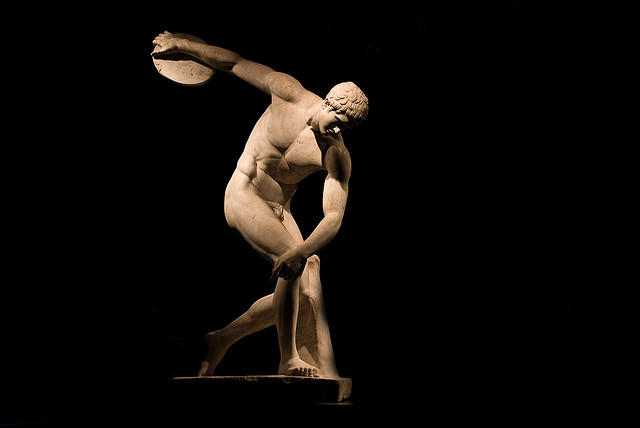
Not so with the ancient Greeks, as the show at the National Museum of Western Art reveals. The main masterpieces of the show, such as the Marble statue of a discus thrower (diskobolos) and Parian marble statue of Aphrodite — both Roman-period copies of earlier Greek statues — are works that are infused with a sense of divine perfection that transcends their minor imperfections.

Sunday, 7 October 2012

Hubert Robert: The Power of the Past


Modernity is characterized by a linear concept of time, with the past cast in the role of an ever-diminishing point on the horizon behind us. One of the charms of the exhibition "Hubert Robert: The Gardens of Time" at the National Museum of Western Art is that it challenges this notion, and suggests that the past may exist as an eternal reality constantly able to interact and influence the present and the future

It could be said that Robert (1733-1808) is one of the chief artistic casualties of modernity's fast-forward surge. The 18th-century French painter was widely known in his day, but is now largely forgotten, existing only as an artistic footnote.

The reason for this is that his art, which features romantic depictions of Roman ruins, often in idealized rustic settings, is basically backward-looking. But while "backward-looking" may sound negative to modern ears, most great artists have looked to the past for strength and inspiration — from the Renaissance painters to the Pre-Raphaelites and beyond.

Like the artists of the Renaissance, Robert's art was firmly focused on the Classical world. In 1754, he moved to Rome to study, and was deeply influenced by Giovanni Battista Piranesi, an Italian artist known for his stunningly detailed prints of Roman ruins. Robert himself fell completely under the spell of these magical ruins, traveling widely in Italy, sketchbook in hand, jotting down scenes in chalk, rather like a modern tourist might take pictures with a digital camera.

The exhibition includes many of these sketches, which often show odd angles or bits of broken wall with no obvious aesthetic merit. It is almost as if the artist was filled with an archaeological need to preserve every relic of the past. Some of the more attractive of these sketches were then worked up into full oil paintings.

The interest in the Classical period during the 18th century was partly driven by the excavation of the cities of Pompeii and Herculaneum, which had been buried by the eruption of Vesuvius in 79 AD, but the Classical world also struck a chord with a European civilization that had moved away from its medieval Christian past. In England, at the same time Josiah Wedgwood was creating his classically influenced ceramics; while in America the Neo-classical edifice of the White House was soon to be built.

The exhibition tries hard to connect Robert with the earlier idyllic classicism of the 17th-century French painter, Claude Lorrain, with several of Lorrain's prints and an oil painting. However, although both artists gave their work an elegiac quality, Lorrain used ruins mainly as a subtle accent, while for Robert they are clearly the main attraction.

Many of the elements revived and rediscovered by Neo-classicism fed directly into the Enlightenment, and from there into the French Revolution, which, in a couple of decades, saw the rise of a Republic and then an Empire in what seemed liked a telescoped version of Roman history.

On one level this was the power of the past at work. Robert's artwork may seem to offer static glimpses of a dead past, but the past rediscovered can be a powerful thing.


C.B.Liddell
Japan Times
5th April, 2012

Saturday, 6 October 2012

Harue Koga: The Art of Assimilating Western Styles

Fireworks

The curse of early Western-style Japanese painters is the charge of derivativeness. Simply because they embraced foreign artistic idioms rather than their own indigenous artistic traditions, it is easy to dismiss them as mere copyists, "regurgitating" whatever it was they saw in the latest imported art photo books or magazines.

Harue Koga (1895-1933), whose art is now being celebrated with a major retrospective at The Museum of Modern Art, Hayama, is particularly susceptible to this accusation because his career shows sharp changes in artistic style that can be correlated to the changing fashions of Western art.

First wetting his brush with a lyrical watercolor style, he later switched to an oil style heavily influenced by cubism and primitivism. A few years after this, his works owe a clear debt to Paul Klee, and then toward the end of his short career there are textbook examples of Surrealism.

But such accusations of derivativeness are a little unfair for two reasons. First, Western artists going through the same learning curve are usually spared the criticism; and second, most of Koga's paintings, even the ones that seem most imitative, lack the stiff, stilted feeling you often get when a certain style or look has obviously been aimed for by the artist.

Although Koga wore his influences on his sleeve, he also took them deep to heart and used them to create works imbued with an original spirit, even if the skin may often have been borrowed.

A good example is The Moon and Flowers (1926). Although it has the patchworklike composition and naive figurative elements favored by Klee, the work also has its own mood. This is even truer in the case of Fireworks (1927), a dreamlike canvas that has much more of an open feel than Klee's often closely- woven works. The trajectory of these two paintings sees Koga still influenced by Klee but moving away and following his own inner muse. The next step is the astounding Innocent Moonlight Night (1929), which poetically juxtaposes a random selection of objects in a way that also prefigures the more overtly Surrealist works that came next.

But what drove Koga along this path?

The thesis of the exhibition is that he was seeking a separate world, "existing somewhere where realistic modes are overcome or severed." Psychologically, this casts the painter in the role of an escapist, and the biographical record suggests he had much to escape from. Like other early Western-style artists in Japan — Narashige Koide and Ryusei Kishida spring to mind — Koga had a relatively hard and short life.

Born and based in Kurume, Fukuoka Prefecture, Koga was unfortunate to experience several tragic events. In 1914, during a stay in Tokyo, his roommate committed suicide. In 1920, the stillbirth of his only child led to the painting of two of Koga's earliest masterpieces, Entombment (1922), which won the 1922 Nika art prize, and Buddhist Service (1923). In 1923 he was also in Ueno during the Great Kanto Earthquake and the next year, with his marriage in decline, he rented a house with a mistress, only to see her die of a disease the year after.

Such experiences may have predisposed Koga toward escapism, but another key element in his outlook was an interest in avant-garde poetry. Through Kongo Abe, an artist who had just returned from Europe, and the poets Kyushichi Takenake and Junzaburo Nishiwaki, he was exposed to French Surrealism. In response he quickly adopted a montage style, juxtaposing images copied from graphic magazines and scientific journals in offbeat combinations.

In Sea (1931), visual snippets from science magazines — an airship, some stylized machinery, and a submarine cut open to reveal its workings — are juxtaposed with a fashionable bathing beauty from a postcard. She seems to stand like the Marianne of the French Revolution, ushering in the new and bewildering age of technology to which Surrealism was a partial response.

The exhibition tries to present this final section as the culmination of his career and vision, but it doesn't quite work. The technical demands the new style placed on him often caused him problems; while, compared with earlier works, there is a loss of warmth and lyricism that can be also be read as symptoms of his declining health. Koga died of a mysterious illness in 1933 at the young age of 38.


C.B.Liddell
The Japan Times
8th October, 2010

Undressing the Myth Behind Goya

What courage!

On first appraisal, it might seem that the organizers have brought the wrong Maja to Japan for the exhibition "Goya: Lights and Shadows" at Tokyo's National Museum of Western Art.

Of course, it would have been best to have included both versions of the painting, because these works, showing the same mysterious beauty in an identical pose, one naked and one clothed, gain by being shown together. But if only one was to be brought all the way from the famous Prado Museum, then surely it should have been the naked one!

Or should it? Although The Clothed Maja (1800-07) may not provide the same immediate thrill as her naked twin, the fact that she is clothed may at least force some of the men in the audience to exercise their imaginations, which cannot be a bad thing in the context of Francisco de Goya, an artist who both painted what he saw and what he imagined, creating images of beauty and horror.

This exhibition skillfully alternates between these two poles of vision and imagination, which are also symbolized by the terms light and darkness, because Goya's mental inclinations tended strongly toward the dark, sinister, brutal, and occult.

In addition to The Clothed Maja, the exhibition includes a reasonable number of other oil paintings and preparatory drawings, and a large number of published etchings from his series, Caprices (1799) and The Disasters of War (1863).

The paintings tell of a rising and successful artist, proud of his well-connected place in high society. One of the points the exhibition makes is that Goya, despite the liberal-progressive myth that has arisen around him, was more of a stakeholder in a Spanish society that was fundamentally hierarchical, traditional and religious.

Although the Majas brought him into conflict with the clerics of the Spanish Inquisition, these paintings were also testaments to the intimacy of his relationship with the aristocracy. They had been painted for Manuel de Godoy, a nobleman who dominated Spanish politics from 1792 until his fall from power in 1808, and were to be hung in his private "cabinet" gallery.

Goya's early paintings, such as The Parasol (1777), an airy and lucid work, reveal the influence of Anton Raphael Mengs, the German neoclassical artist who was very influential at the Spanish court during the reign of Carlos III (1759-1788). But Goya's style soon asserts itself in his taste for darker or more comic scenes such as Maja and Cloaked Men (1777), where we get a sense of Spanish society as a rather exotic world outside the European mainstream.

In the large, official works, such as his excellent portrait of Carlos III's successor, Carlos IV in Red (1789), the painter is obviously serving the wishes of his royal client more than expressing himself, but when we turn to the sketches and etchings at this exhibition, there is no doubt that we are in the presence of Goya's own personality. The man we meet is a witty and acidic observer of his own society, but also a morose character seemingly tormented by an overabundantly dark imagination.

His keen satirical bent is one of the reasons why Goya is often anachronistically viewed as something of a liberal progressive in tune with the ideals of 1789's French Revolution. Dream of some men who were eating us up, an etching and aquatint from his Caprices, parodies greedy, parasitical Christian monks. But, if anything, this is a very respectful image compared to some of the others in the series, which show teachers as donkeys and bestial witches, and take a very dark view of relations between the sexes. All will fall and There they go plucked, two etchings from this series, show birdlike male courters snared and literally plucked by a gang of cynical women.

One of the other myths countered by the exhibition is that of Goya the ardent Spanish nationalist. This view is largely based on The Disasters of War series, showing the horrors that followed Napoleon's takeover of Spain in 1808 and the popular uprisings that followed. Viewed on its own, a print such as What courage!, which shows a woman firing a cannon because all the men have fallen, suggests that Goya was ready to take up arms himself — but his actions during the war paint a different picture. Rather than joining the Spanish rebellion, Goya remained in his post as court painter in French-controlled Madrid.

Although his depictions of the atrocities of war reveal the brutalities inflicted on the civilian population by the French occupiers, there is a moral ambivalence to most of these works that is best observed in a pair of etchings titled Rightly or Wrongly and The Same. The first shows French troops killing poorly equipped Spanish rebels, while the second shows similar partisans hacking Napoleon's soldiers to death.

Goya's attraction to this kind of subject matter seems more a reflection of his own dark moods and health problems, which included deafness, than any wish to start the early 19th-century equivalent of Amnesty International. Whether it was witches, greedy priests or the brutalities of war, his obsession with the dark side of life comes across as the essence of his personality. The Majas, it seems, were merely work.


C.B.Liddell
The Japan Times
3rd November, 2011

Rules are Made to be Broken: Gervex, Renoir, Cezanne & Picasso

Woman Seated in an Armchair, 1923

Nowadays an artist has complete freedom to paint, carve, construct, install, or simply do whatever he wishes in order to convey his vision or effect the way we see or think about the World. This laissez faire state of things didn’t just happen by chance but was the result of the Modernist revolution, a century of artistic turmoil that broke away from conservative expectations of what art should be. The current exhibition of 63 paintings and sculptures from the Detroit Institute of Arts at the Yokohama Sogo Museum allows us to revisit this exciting period in all its diversity with such great names as Degas, Renoir, Van Gogh, Matisse, Picasso, and Modigliani.

To relive the excitement of this revolution and derive the maximum pleasure from the exhibition, it should be remembered that everything, from the choice of subject, composition, and color scheme, down to the tiniest brushstroke, were once governed by the precepts of the 'academic style,' an aesthetic that looked back to the masterpieces of the Renaissance and was enforced, in France, by the Salon, a government sponsored art show.

Henri Gervex's large oil painting, Cafe Scene in Paris (1877), which presents a competently painted slice of normal life, may look unremarkable to the casual viewer, but its choice of subject matter and its candid composition break the rules. A figure on the right is cut by the side of the picture while on the left empty space is left. The two figures in the foreground both sit turned to the right. This asymmetry, together with the plush interior of the cafe, creates a feeling that the picture is moving like a train carriage to the right. 


The Spanish Guitarist
The Spanish Guitarist (ca. 1894–97) and Graziella (ca. 1910–12) are instantly identifiable as Renoirs, revealing the soft, feathery brushstrokes that the artist evolved from the broken brushstrokes of his earlier impressionist works. Renoir was always a reluctant revolutionary and both these works show his interest in classical composition that revived in his later years.

With the absence of Monet at the exhibition, the most revolutionary of the early Modernists on display is Paul Cezanne. Initially associated with the Impressionists, he wanted, in his own words, to create something more solid and durable, like the art of the museums. Grouping parallel, hatched brushstrokes in formations that built up a sense of mass, his work was more appropriate to landscape than the human form.

His Bathers (ca. 1880–82), a group of androgynous figures, is not nearly as satisfying as Mont Sainte–Victoire (ca. 1904–06), a painting of a local landmark near his home at Aix in the South of France. Cezanne's brushstrokes convey both a feeling of the landscape, but also make us aware of his work as an act of painting and therefore as an object in itself. It is this quality that was so influential in later years and earned Cezanne the title of "Father of Modern Painting."

Picasso, especially in his Cubist works, was deeply influenced by Cezanne, but his composition, Bottle of Anis del Mono (1915), suggest that he took Cezanne's ideas too far. Recreating this object as a totem reduces it to a caricature, diminishing its aesthetic impact. Perhaps this was why Picasso later rejected Cubism. His large Woman Seated in an Armchair (1923) reverts to classical composition, creating an effect of bulk and serenity, while keeping the artist’s spontaneity with its rough unfinished surface.

The restlessness and innovation of these artists struck a chord with the public, elevating the artist from mere craftsman to visionary and maker of icons. Ultimately the artist himself became a kind of icon: My enduring memory of this exhibition is of an old lady camped out in front of the sole Van Gogh on display, a self portrait from 1887 that stared back with burning eyes.


C.B.Liddell
International Herald Tribune Asahi Shimbun
5th May, 2001


Thursday, 19 July 2012

Isamu Noguchi: To Touch the Earth


The Law of Unintended Consequences interferes with the way the World is supposed to be, but it can also throw a spanner in the works of exhibitions that set out to present a certain view of the artist and his art. The exhibition held to celebrate the centenary of the sculptor Isamu Noguchi is an example of such an agenda becoming gloriously derailed.

During his lifetime (1904 – 1988), Noguchi became something of a 'UNESCO Man,' a symbol of the new "transcendent humanity" that could supposedly exist far beyond ethnicity; a bit like the futuristic world portrayed in the 1960s Star Trek TV series. In recent years this universalist notion has become increasingly tarnished as the tyrannies that best exemplified it – the Soviet Union and Yugoslavia – have crumbled and tribalism runs rampant in our world. However, it still lingers in those places where it is least likely to cause a problem or actually exist, namely mono–ethnic states like Japan where they continue to pay lip service to such idealistic and unrealistic notions, as with this exhibition.

Chika Mori, a curator, at the Museum of Contemporary Art, Tokyo, is quite happy to express the formula.

"He's not Japanese and he's not American," she says expansively. "He's a man of the Earth. Nationality is not important. He had no idea of boundaries of barriers, both nationally and artistically."

This is clearly how this exhibition intends to present Noguchi – as a universal figure and a cosy symbol of our globalized World, but the closer you look at his art and life – and this exhibition helps you to examine both – the more this cosy narrative implodes, with Noguchi's story becoming a case of an artist unable to escape from the ethnic dimension or to achieve fulfilment through it.

Although now often thought of as a Japanese artist, Noguchi was born in the USA, had a White American mother, and lived most of his life in the States. For a time, it seems that he even tried to be an all-American boy, graduating from high school in Indiana as Sam Gilmour (his mother's surname), before deciding to 'become' Japanese by adopting his father's surname. His decision to 'be Japanese' did not include settling in Japan, as he continued to live in America, apart from an extended stay in Japan in the immediate post-War period.

It is possible to see his adoption of Japanese identity as a cynical career ploy. Presenting himself as Japanese obviously gave his art more of an exotic cachet than it would have had under his WASP-sounding moniker 'Sam Gilmour.'

"When he was living in New York, there was a trend that respected Japanese culture," Mori explains. "He was also inspired by Zen and started to notice he was Japanese."

Despite this, early works, like Globular (1928), a smooth lump of polished brass, have little to characterize them as Japanese. They reflect instead the abstract minimalism and international modernism that Noguchi imbibed as an art student in New York and Paris, and as an assistant in 1927 to the Romanian sculptor Constantin Brancusi.

Other key works, like the vaguely sexual Avatar (1947), owe an obvious debt to the biomorphic forms of the Surrealists.

However, his assumption of Japanese identity went deeper than seeking to benefit from art consumer trends and an appetite for the exotic. In the post-War years it seems he made a more concerted effort to expand his Japanese identity, marrying a Japanese actress Yoshiko Yamaguchi, who had identity issues of her own, and, for a time, even living in a traditional house in Gifu Prefecture, where he designed paper lanterns for the local paper–lantern industry. By bringing his art into countless households, it was these lamps that literally made him a household name.

It is easy to read this period of his life as an attempt to 'come home' to his Japanese roots. However, unlike America, racial categories in Japan have always been much more rigorous and exclusionary. This was driven home for Noguchi when, after doing some minor work for Hiroshima's Peace Park, his design for the "Memorial to the Atomic Dead of Hiroshima" was rejected simply on the grounds that he wasn't Japanese.

This drove home the fact that Noguchi would never be fully accepted in Japan, something he later expressed when he wrote of the Chinese-American artist, Li–Lan.

"In the same way as I do, she belongs to that increasing number of not exactly belonging people."

Nevertheless, he continued to follow his interest in Japanese aesthetics. Indeed, following his disenchantment with being accepted as Japanese, the quota of 'Japanese-ness' in his art actually increased. Late sculptures, like the confusingly titled Chinese Sleeve (1987), made from flat sheets of black bronze, sharply folded as if to mimic origami, have an unmistakable Japanese character. With the conventional way of becoming Japanese blocked, it's as if his art became the path to reach this elusive goal. Nothing makes this more obvious than the direct reason for the exhibition.

"Although one year late for his centenary, we decided to have this exhibition this year to celebrate the opening this year of Noguchi's last great project, Moerenuma Park in Sapporo," Mori explains.

The exhibition includes a scale model of this extensive leisure site, as well as photographs, and design models. This project for a park was a massive advance on Noguchi's small 'Zen–themed' gardens, like the one he created for the UNESCO Headquarters in Paris in the 1950s. Begun in 1989, it was very much a product of the economic expansiveness of the Bubble Years.

"A normal park has no ups and downs," Mori points out. "But for this park he built mountains and ponds. He wanted to directly touch to the Earth."

Although Mori enthusiastically sees in this an ecological message of the universal man living in harmony with nature, the Law of Unintended Consequences allows a different message to emerge from the exhibition, casting Noguchi's desire to touch the Earth as a final, desperate attempt to leave his mark on the land that rejected him.


"Isamu Noguchi: From Sculpture to Spatial Design" was held at the Museum of Contemporary Art, Tokyo, from September 16 to Novenber 27, 2005


C.B.Liddell
Previously unpublished
October, 2005

Saturday, 7 July 2012

American Impressionists: Following Monet to the Country

Self Portait (1896), F.W. MacMonnies

The charm of Impressionism was that it allowed a great deal of artistic freedom and expressiveness without losing touch with realism. A good impressionist painting allows us to recognize a scene, while encouraging us to see it in new ways. This quality of blending the real with something more ethereal and escapist also seems to have been present in the lifestyles of the American artists featured in the Bunkamura's "Monet and the Artists of Giverny" exhibition. Just like expats here in Japan many of these artists found a freedom in France that they couldn't at home.

The way the exhibition has been organized, using Monet's name power to bring in the crowds, curiously echoes the story that the exhibition tells. In 1883 Claude Monet moved to the small village of Giverny near the banks of the lower Seine. Over the following years leading up to World War I, a total of around 300 artists came there to paint. Some settled permanently or for a few years, most just stayed for the summer season. Of these more than 70% were Americans, in effect turning the village into an American art colony, centered round the great French Impressionist, who continued to live here, developing his lily ponds and water garden and painting them until his death in 1926.

For these Americans, Giverny was a kind of comfortable compromise between the artistic ideal of immersion in French rural life, something that most of them were not really suited for, and their more practical needs. The town's sole hotel, the Hotel Baudy soon learnt to accommodate the outsiders and make them feel at home, with English tea and pudding and Boston baked beans.

The exhibition uses Monet as a kind of framing device. The first section presents a few Monets alongside works by American artists that echo them, although often the echoing is merely because they are painting the same scenery. Monet's Winter in Giverny (1885), showing a townscape in the distance cropped by a snowy hillside in the middle distance, seems to have been the inspiration for Theodore Robinson's similar scene Winter Landscape (1889), which won the young American painter his first art prize when it was exhibited back in America.

There is also a series of studies of a haystack, Studies of an Autumn Day, 1-12 (1891), painted at different times of the day by John Leslie Breck that is a clear attempt to follow Monet's practice of repeatedly painting the same object in order to better understand the nature of light. But while Monet's astounding masterpiece Grainstack (Sunset) (1891) is essentially about light rather than the object it touches, Breck's studies end up being more about the haystacks, showing the difference between a talented master and a mediocre follower.

Interestingly, Willard Leroy Metcalf's The Lily Pond (1887) seems to predate any of Monet's paintings on the same theme at the exhibition by quite a few years, suggesting that the influence might not have always flowed one way, but possibly two. These paintings by Monet of his water garden and lily pond are usually seen as the culmination of his career, so it is intriguing to think he might have been given the hint by a young Bostonian.

Some of the Americans attained great skill. In Frederick Carl Frieseke's Lady in a Garden (c. 1912), energy is built up through a colorful claustrophobic composition that avoids depth, and is then released in long, intense brushstrokes that represent the flower stems, which blend with the pattern of the lady's dress.

But more often than not, placing these painters alongside Monet tends to emphasize their tourist credentials. When Monet looked at a scene he saw light and the way it touched things, and didn't think of himself as an artist because he was one. With the Americans, by contrast, the exoticism and picturesque quality of the things they saw often intrudes, creating a kind of preciousness, and then there's the self-consciousness brought about by living "the life of an artist" in France.

Although an attractive painting, Louis Ritman's Early Morning (1912-15), with its sexily disrobed model, nevertheless seems have some of that ooh-la-la quality associated with young men exploring the seamier side of France. Elsewhere, in Frederick William MacMonnies' Self Portrait (1896), there is the unmistakable scent of someone entering into the role of "artist." All that's missing in this work is the standard issue artist beret.

I'm not sure if this exhibition works as an exploration of American Impressionism, as Impressionism is certainly more interesting viewed internationally than through the prism of one country, but, viewed as a show that explores the dichotomy between artistic genius and pretensions to it, the exhibition comes into its own and has an interesting tale to tell.


C.B.Liddell
The Japan Times
14th January, 2011

Thursday, 5 July 2012

Vermeer and the Delft Style


Something "New" From the 17th Century


Because of the tight loop of Japan's media and information sources, audiences here sometimes have a tendency to pick up and magnify certain international trends. This creates booms in film, fashion, and even fine art, as seen with the popularity here of the 17th-century Dutch painter Jan Vermeer.

His subtle paintings of quiet domestic scenes are now attracting hordes of art fans to "Vermeer and the Delft Style," at Tokyo's Metropolitan Art Museum, which presents seven of his canvases – a record for Japan – along with a number of other paintings from associated artists, including Pieter de Hooch and Rembrandt's talented student Carel Fabritius.

The great popularity of Vermeer is remarkable because, until a few years ago, hardly anyone in Japan knew his name. Now everybody does.

"Some years ago the big name in Dutch painting for Japanese people was Rembrandt, but now it is Vermeer," Satoshi Otoba, curator at the Tokyo Metropolitan Art Museum says.

But what can explain this upsurge in popularity? Obviously, being coupled with Scarlett Johansson through the speculative biopic Girl with a Pearl Earring (2003), didn't hurt, but, by then, Vermeer's popularity was already in the ascendant. The true reason has more to do with market dynamics and demography.

Just like cinema audiences and music fans, Tokyo's art public has a constant need for something new. The desultory nature of contemporary art often fails to satisfy this craving, especially as, according to Otoba, Tokyo's art public is dominated by older and retired people. With the free time and money to visit exhibitions, this group dominates art audiences, and, on the whole, tends to have classical and conservative tastes. For this group, novelty consists of finding overlooked artists from the past, rather than dissected cows in tanks of formaldehyde or video installations by people "explicitly addressing gender issues."

"Vermeer's image for Japanese people is aesthetically comfortable but mysterious," Otoba explains. "This is the key to his boom."

This mystery stems partly from the shadow of neglect, which hung over genre paintings for centuries. Many of the pictures at this show, like Vermeer's The Little Street (1660) [see above image] or Pieter de Hooch's Woman with Children in an Interior (1658), resemble candid snaps of everyday 17th-century life, except for the fact that they are meticulously rendered in oils. The skill of these painters has never been in dispute. Vermeer's ability to create intimate space through subtle composition and delicately managed light and shade are impressive. But the main criticism was that such skill was employed to "say" very little.

"Most pictures of the Dutch school," the Victorian critic John Ruskin wrote, "are ostentatious exhibitions of the artist's power of speech, the clear and vigorous elocution of useless and senseless words."

Otoba dates the unpopularity of genre paintings from the rise of French power in the 17th century. Along with the hard power of Louis VXI's armies, the French also started to exercise 'soft power.'

"The French controlled politics, economy, and art," he explains. "The French Academy decided a hierarchy that placed religious and mythic paintings high above genre paintings."

In these more secular and dumbed-down times, a lack of mythical, allegorical, or religious narratives has become a strength – especially here in Japan. Modern audiences look at Vermeer with a degree of material fetishism, enjoying the skillfully created sense of reality, without feeling troubled by a need to fit it into a broader framework of meaning.

The paintings also appeal to a modern psychological sense. In Woman with a Lute (1665), the privacy of the interior and the woman's unguarded demeanor creates a sense of intimacy and a feeling sympathy, even though we see her from the position of a voyeur, unseen in the shadows of the room, and know next to nothing about her.

Masterly technique, a lack of cultural baggage, and a sense of mystery makes Vermeer the perfect painter for Tokyo's dominant art demographic.


C.B.Liddell
The Japan Times
10th October, 2008

Tuesday, 19 June 2012

Ryusei Kishida: Innovation and Exploration

Kishida’s short but brilliant career


When Japan opened up to the West after the Meiji Revolution, it had a lot of catching up to do. Achievements that took hundreds of years to develop in European civilization were transplanted to Japan in a few decades. This could only be done through the stupendous efforts of some very talented and dedicated reformers. In the art world, one such person was Ryusei Kishida (1891-1929) whose tragically short career helped Japanese Western-style painting make up much of the distance that separated it from its foreign models. To commemorate the 110th anniversary of his birth, a major retrospective of his art is being held at MOMA, Kamakura, which is itself celebrating its 50th anniversary.

Early works like his watercolor Sea at Dusk (1907) and his oil painting Sukiyabashi, Ginza (ca.1909) show the work of a young artist who had already mastered much of the language of Impressionism. However, Kishida was not content to rest on his laurels. Through the influence of his friend, Mushanokoji Saneatsu, and the forward-looking art magazine, Shirakaba, he became interested in post-impression. His Self-Portrait (1912) with its thick, parallel brushstrokes in vivid colors echoes the expressionism of Van Gogh and Munch, while Toranomon (ca 1912) suggests an attempt to create texture in the style of Cezanne.

By temperament, Kishida was attracted to the work of William Blake, the Christian poet, artist, and engraver who was inspired by mystic visions. His ink on paper study for his 1914 work, Striving of Humanity, with its naked Biblical forms, is a clear tip of the hat to the Englishman.

Fired with an almost mystical sense of nature himself, Kishida viewed beauty as a unique reality. Dissatisfied with his technique, he was drawn towards the clear, precise paintings of the Northern Renaissance. While convalescing from the consumption that finally killed him at the early age of 39, he would lovingly study art books showing the works of the likes of Van Eyck and his favorite, Albrecht Durer. His finely detailed Portrait of the Artist's Wife (1915) as well as his two dark, somber portraits of his friend, Mitsuji Takasu, from the same year, show a mastery in this new direction.

At this time, Kishida was living in Yoyogi. In those days, although still largely a rural area, it was starting to be engulfed by Tokyo's suburban sprawl. Some of his most accomplished work are his landscapes showing this transition, like Red Earth and Plants and Road Cut through a Hill, both from 1915, which show lifelike sky and earth tones combined with an expert use of light.

In 1917, he moved to the healthier climate of Kugenuma in Kanagawa. Here the limitations of his illness forced him to concentrate more on still lifes and close members of his family, especially his daughter Reiko, born in 1913. Sometimes enchanting at other times sinister, these portraits of Reiko are his most baffling and intriguing works. Photographs show that Reiko was in fact a rather pretty little girl, however in the portraits, Kishida exaggerated the width of her head to create a sometimes grotesque effect. Contrast the charm of Reiko Eight Years Old in Western Dress (1921) with the rather spooky atmosphere conjured up by A Little Girl 1922).

During this period, Kishida became interested in Oriental art. This can be seen in a wide variety of works, including the oil painting, Portrait of the Artist's Sister Teruko in Chinese Dress (1921). Using traditional Japanese methods and forms like sumi-e and scroll painting, he created pleasant but not particularly breathtaking works like White Gourd and Eggplants (1926). He also became interested in Song and Yuan period paintings and early hand-painted ukiyo-e, but before he could achieve a true synthesis between Western and Eastern art, fate took a hand. His interest in Oriental art led him to visit China in 1929. During this trip his illness suddenly worsened and one month later he was dead.

Kishida was an artist of great technique who successfully absorbed a wide range of Western styles. We can only imagine what his interest in Oriental art might have produced if he had been allowed to live a few years longer.

Ryusei Kishida runs until May 20th, 2001, at the Museum of Modern Art, Kamakura, in front of Tsurugaoka Shrine, Kamakura City.


C.B.Liddell
Japan Times
16th May 2001

Thursday, 19 April 2012

Czartoryski Collection: East Meets West, with Leonardo in a starring role


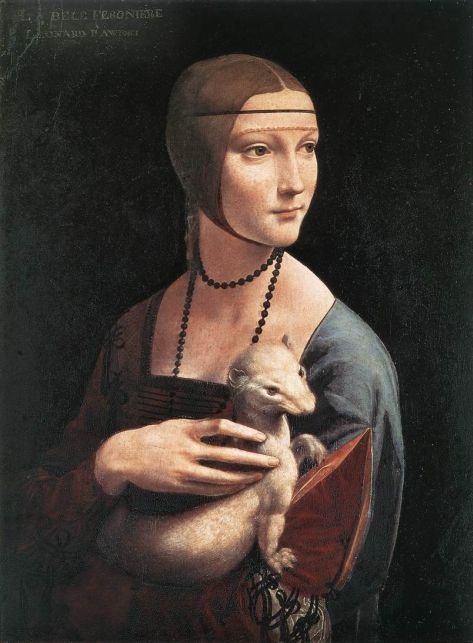
When it comes to artistic reputations, nobody except perhaps Michelangelo ranks quite as high in the pantheon of art as Leonardo da Vinci. This is surprising in view of the fact that only a handful of his finished paintings survive. Indeed, there are just seven places in the world that can boast a finished painting by da Vinci, the Czartoryski Museum in Cracow, Poland, being one of them. The arrival in Japan of da Vinci’s Lady with an Ermine (c.1490) has therefore overshadowed the other works from the Polish museum now on display at the monumental Yokohama Museum of Art.

There are very few other famous artists in evidence. Perhaps Carlo Crivelli, here represented by the lackluster St. Anthony the Abbot and St. Lucy (c.1470), ranks a very distant second. I ask curator Hideko Numata if there is not a danger of the exhibition being seen like a movie with one big star and a supporting cast of unknowns?

"I see what you mean," she responds. "But if people come they can see other beautiful works like Vincenzo Catena's Virgin with Child."

Although Lady with an Ermine works a little like the cheese in a mousetrap, it is unquestionably a very tasty morsel. Kept in a room all by itself the painting is surrounded by an atmosphere of intense reverence with devotees standing enthralled, many of them busily sketching.

But this is not some celestial icon, but a fresh, candid portrait of a worldly beauty, Cecilia Gallerani, the mistress of Leonardo's patron, the Milanese strongman, Ludovico Sforza. Although the Mona Lisa best shows Leonardo's technique of sfumato (imperceptible changes in gradation of light and color), in other respects the Lady with an Ermine is superior to its more famous sister in the Louvre.

The Polish work is more refreshing in terms of composition and atmosphere, giving us the sense of a thinking, feeling being caught in a snapshot. There is also an intriguing visual hook in the ermine the lady holds. As a traditional symbol of purity and nobility, the weasel-like creature sits uneasily in the hands of the young temptress.

One can't help thinking that Leonardo chose it for visual reasons. With her hair tightly tied under a hair net, Gallerani’s head looks small while her hand looks unnaturally large and masculine. This jarring note attracts our attention, but is then expertly balanced by the presence of a creature with a relatively large head and tiny paws.

But the most interesting story at this exhibition is not Leonardo's but Poland's. When the Czartoryski Museum was founded in 1801, Poland had been literally wiped from the map and divided among its stronger neighbors. The founder Princess Izabela Czartoryski intended the museum to serve as an inspiration to the Polish people, reminding them of their glorious past. However, looking at the devotional paintings and mythological engravings from Italy, the Majolica vases from Spain, and the crystal and silverware from Germany, the impression the viewer is more likely to get is of a poor country cousin trying catch up with the sophisticated tastes of the West of Europe.

Nothing brings this home more strongly than an early 18th century painting, King Jan III Sobieski at Vienna 1683. This expansive work by an anonymous artist shows the Polish army saving Vienna from the besieging Turks. What strikes the viewer, however, is not the heroism of the Poles in the common defense of Europe, but the Asiatic look of their clothes and accouterments. With his exotic robes, fur hat, and curved saber, and with his wild-looking cavalrymen, some even mounted on camels, the Polish king looks every inch a Central Asian khan.

This exhibition suggests that Poland, despite its position at the edge of the great Eurasian plain, increasingly turned to Western Europe for its culture and identity. In this clash between the wildness of the steppes and influences from the West, Leonardo's painting is an exquisite detail.

Leonardo da Vinci Lady with an Ermine: Treasures from the Princes Czartoryski Museum ran until Apr. 7 at the Yokohama Museum of Art.


C.B.Liddell
International Herald Tribune Asahi Shimbun
9th March 2002

Sunday, 15 April 2012

Crossing the Line: The Vienna Secession

Fatalism (1893) by Jan Toorop

Our idea of the fin de siècle avant-garde artist is of an impoverished outcast, ignored by the establishment, whose genius was only recognized after death. This fits in with our view of art as something ethereal that doesn't quite belong in the material world. However, except for a few tragic cases, artists are just as practical and hard-headed as the rest of us. This is also the impression given by an exhibition of art from the Vienna Secession at the Bunkamura.

Saturday, 14 April 2012

Merzbacher Collection: Unleashing the Power of Colour

The Beak of the Eagle, La Ciotat (1907)

The keynote of the exhibition at the Yasuda Kasai Museum [*now renamed the Sompo Japan Museum] in Shinjuku is the brilliance and vividness of color. Featuring painters associated with Fauvism and German Expressionism, the show includes 87 works of astounding color from the extensive collection built up by Werner Merzbacher, a wealthy Zurich-based fur merchant and financier.

In view of the fact that both Merzbacher's parents died in a Nazi concentration camp, the importance of color as a symbol of life cannot be overstated. Steven Spielberg, when he came to shoot Schindler's List, felt that color was an inappropriate medium for the Holocaust, and so filmed the movie in black and white. Seen in this light, Merzbacher's obsession with intensely colored pictures suddenly makes sense.